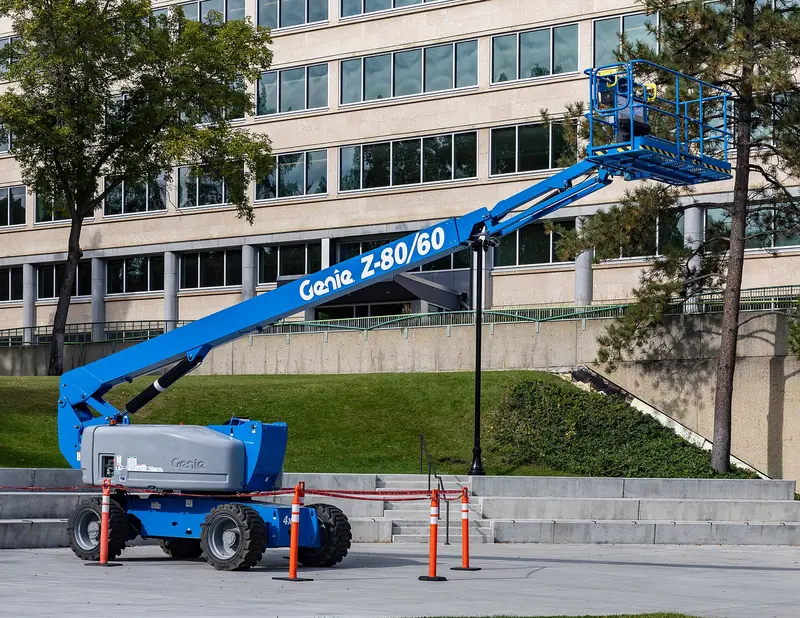

Why a straight arm reaches farther
The arm is nested sections that slide out. Because the platform moves along one line, it can sit far from the base. A JLG 600S has a platform height of 59 ft 6 in and a horizontal outreach of 50 ft. A JLG 800S in the next class shows 71 ft of horizontal reach, while a Genie S80 of nearly the same working height shows 54 ft 9 in.
That gap is the reason to ask for the exact make and model. Two machines sold as an 80-foot lift can differ by more than 15 feet of outreach.
Numbers worth knowing before you order
Weight is why these machines need firm, level ground. The JLG sheet lists a maximum ground bearing pressure of 78 psi for the 600S, which works out to roughly 11,000 pounds on each square foot under a tire.
| Machine | Platform or working height | Horizontal reach | Weight |
|---|---|---|---|
| JLG 600S | 59 ft 6 in platform | 50 ft | 21,461 lb |
| Genie S60 | 67 ft 2 in working | 40 ft 6 in | 17,750 lb |
| JLG 800S | 86 ft working | 71 ft | 34,150 lb |
| Genie S80 | 86 ft 5 in working | 54 ft 9 in | 24,500 lb |
Work that calls for distance
Pick a telescopic boom when you need reach more than flexibility.
- Tank, pipe rack and structure maintenance at the refineries and chemical plants along the ship channel.
- Metal building, tilt-wall and steel erection on open sites.
- Billboard, light pole and communication work.
- Cladding, coating and inspection on tall buildings with a clear approach.
- Storm cleanup and tree work in open areas.
Price signals for the larger classes
One Houston guide lists 60 to 80 ft rough-terrain telescopic booms at about $450 to $900 a day and 100 to 125 ft machines at about $900 to $1,600 a day. A marketplace page for straight booms in Houston shows an average of $648 a day across listings, with listings starting around $311. These are not quotes. They show that price climbs fast with height, and the biggest sizes need a special trailer and more notice.
The cost guide puts the ranges in one table with the sources. If you do not need the outward reach, an articulating boom may cost less for the same height.
Ground and wind with a long arm
Wet Gulf Coast clay after rain is a common cause of delays, and a yard may ask for plywood or steel plates under the tires. See boom lift site requirements for ground loads and slope ratings.
Wind matters more with a long arm. One Genie boom manual says not to raise the boom when winds may exceed 28 mph, so plan a spare day for outdoor work.
Common questions
How high does a telescopic boom reach?
Rental machines run from about 40 feet to well over 100 feet. Outreach is lower than the height figure and changes with the boom angle. Give the yard the height and the distance out.
Which is better, telescopic or articulating?
Neither. A telescopic boom reaches farther in a line. An articulating boom reaches around and over things. Tell the yard what stands in the way.
Can it work on soft ground?
Rough-terrain models travel on packed dirt and gravel, but wet clay and fill are different. Describe the surface and ask whether mats or plates are needed.
What paperwork does a yard want for a large machine?
It varies by yard. Expect questions about the renter's identity, proof of insurance and who will run the machine. The first-time checklist lists the usual ones.
Sources
- JLG 600S and 660SJ telescopic boom spec sheet
- MacAllister Rentals, 60-foot straight boom lift specifications
- MacAllister Rentals, 80-foot straight boom lift specifications
- CountBricks, Boom Lift Rental Rates in Houston (2026)
- DOZR, Straight boom lift rental options in Houston, TX
- Genie Z-34/22 IC operator's manual, safety rules page