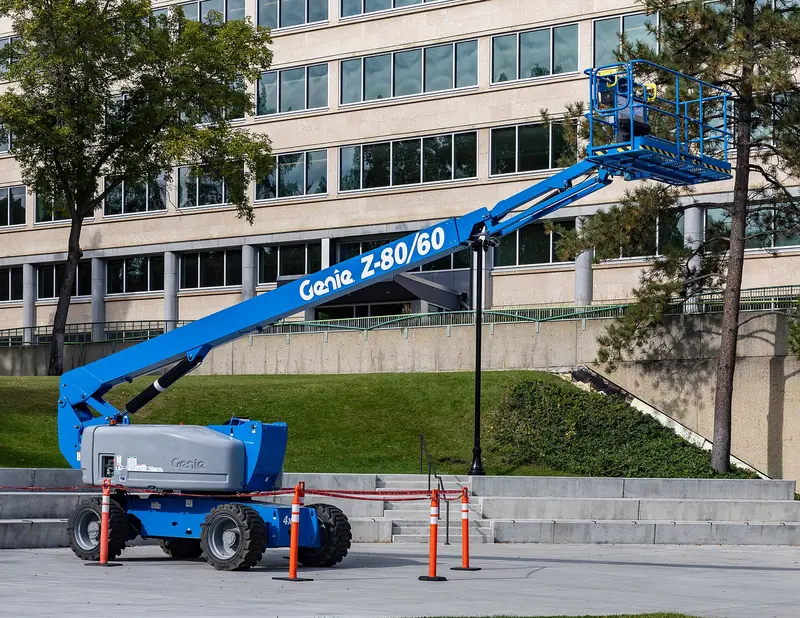

How the jointed arm changes what you can reach
The arm has one or more joints, so the platform moves up, out and down in a curve. A turntable at the base rotates the whole arm. Electric and hybrid versions run quietly enough for indoor and shopping-center work, and a jib at the tip adds a final bend for tight corners.
The number that separates this machine from a straight boom is up-and-over clearance, the height of an obstacle the basket can clear and still reach behind it. Rental listings for a 40-foot-class electric unit show about 21 feet of up-and-over and 22 feet of horizontal reach. A 60-foot-class unit shows roughly 26 feet of up-and-over and 40 feet of reach.
Measured sizes from two common classes
These figures come from manufacturer specifications reproduced on a rental company page, not from a Houston yard. A yard's own machine can differ, so ask for the model and check its range chart.
| Class | Working height | Horizontal reach | Width | Basket capacity |
|---|---|---|---|---|
| 40-ft electric (JLG E400AJP, Genie Z40/23N) | 46 ft to 46 ft 5 in | about 22 ft 5 in to 22 ft 8 in | 4 ft 11 in | 500 lb |
| 60-ft class (JLG 600AJ, Genie Z62) | 66 ft 7 in to 67 ft 11 in | about 39 ft 7 in to 40 ft 9 in | 8 ft 2 in | 500 lb |
Jobs where the bend earns its cost
An articulating boom is usually the right call when something stands in the way.
- Exterior painting, sealing and sign work above landscaping, awnings or canopies.
- Tree trimming close to a building, where the basket must go over a roofline.
- Steel, duct and conduit installation in a warehouse with racks or machines below.
- Access to rooftop units where a ladder is not permitted on the site.
- Light changes in an atrium, gym or parking structure.
What the price depends on
One Houston cost guide lists 30 to 40 ft electric articulating booms at about $350 to $650 a day and 45 ft rough-terrain diesel articulating booms at about $325 to $525 a day. Both are planning ranges from a marketing site for estimating software, so use them to judge a quote rather than to predict one. The full cost guide shows the weekly and four-week ranges and the extra charges.
Working height and power type move the number most. Indoor work usually points to electric with non-marking tires. Outdoor work on gravel or dirt points to diesel or dual-fuel with four-wheel drive, which costs more.
Checks before it arrives
Most delays are about ground and access, not the machine. Soft dirt, a sloped drive or a low gate can stop a delivery. The site requirements guide covers ground loads, slopes, wind and overhead lines in detail.
A 60-foot-class articulating boom is 8 ft 2 in wide on the specification sheet, so it will not pass a standard gate or door. A small electric unit at 4 ft 11 in may. If the job is higher than 60 feet or needs more outward reach, compare it with a telescopic boom.
Common questions
Can an articulating boom drive indoors?
Many electric models are built for it. Check floor loading and the width of doors and aisles, and ask for non-marking tires if the floor is finished.
How many people fit in the basket?
The two specification tables above list a 500 lb basket capacity. That is usually two people plus light tools, but the rating on the machine's own plate is the one that counts.
What is a jib?
A short extra arm at the tip of the main boom that tilts the basket. It helps in tight corners, and a yard may charge for it as an accessory.
Who sets the delivery and pickup terms?
The yard does. Delivery is usually its own line on the quote, so ask what it covers and when the rental clock starts and stops.